
Most people walk into a jewelry store knowing two things about diamonds: they’re expensive, and they’re supposed to last forever. What a lot of them don’t know is that since 1954, people have been growing actual diamonds in labs. For most of the decades since, the jewelry trade hasn’t exactly gone out of its way to mention it.
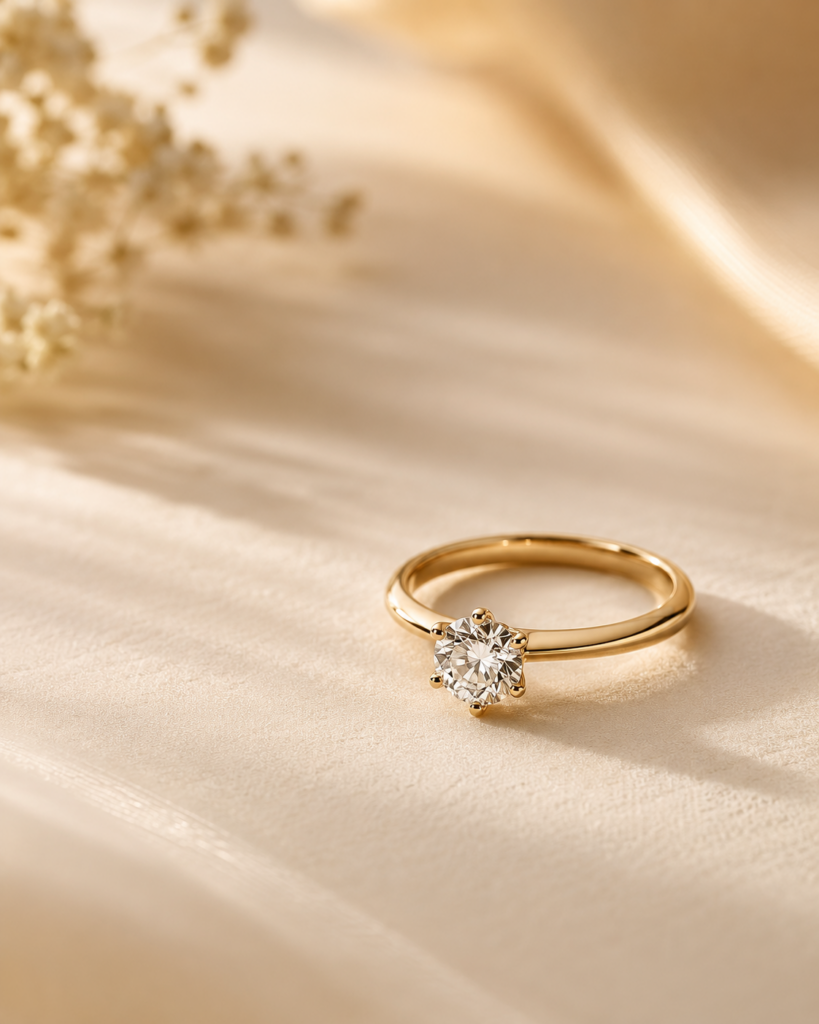
That’s changing now, mostly because customers started asking better questions.
A Diamond Is a Diamond, Wherever It Was Made
Here’s the part the traditional trade doesn’t put on a billboard: a lab-grown diamond and a mined one are chemically and physically identical. Same carbon structure. Same hardness, a 10 on the Mohs scale, which happens to be the hardest naturally occurring material there is.
The only real difference is where it came from. One formed underground over billions of years under enormous heat and pressure. The other was grown in a chamber that recreates those same conditions, just a lot faster.
That’s genuinely the whole story. There isn’t a catch hiding underneath it.
A trained gemologist can’t tell the two apart by looking at them. Even with lab equipment, telling them apart takes specialised testing built specifically for that job. So if someone tells you a lab-grown diamond “isn’t a real diamond,” they probably just haven’t looked into it much.
So How Does a Lab Actually Grow One?
There are two ways it’s done, and honestly, both are a little strange to think about the first time you hear them.
| Method | How It Works |
|---|---|
| HPHT (High Pressure High Temperature) | A small diamond seed goes into a chamber and gets subjected to roughly the same pressure and heat you’d find in the earth’s mantle. Carbon atoms build up around the seed layer by layer until it’s a full diamond. |
| CVD (Chemical Vapor Deposition) | A diamond seed sits in a chamber filled with carbon-rich gas. The gas gets ionised into plasma, and carbon atoms settle onto the seed and crystallise. This is the method that tends to produce the purer stones, which is why it’s become the more common choice for gem-quality diamonds. |
Different process, same outcome. Neither one is the “fake” version of the other.
The Question Every Indian Family Asks
Let’s be honest about this one. Bring home a lab-grown diamond in most Indian households and someone, probably an aunt, is going to raise an eyebrow across the dinner table. “But is it a real diamond?” And under that question is usually a second one nobody says out loud:
Will people be able to tell it isn’t the “real” thing?
It’s a fair worry. Diamonds carry a lot of weight in Indian households that has nothing to do with chemistry. Status, tradition, what gets passed down at a wedding. A diamond here is rarely just jewelry.
Which is exactly why it’s worth answering properly instead of brushing it off.
A lab-grown diamond is the real thing. It won’t cloud up. It won’t go dull in ten years. It’s not the same category as cubic zirconia or moissanite, which are different materials entirely and only resemble a diamond from a distance. A lab-grown stone isn’t trying to pass as a diamond. It is one, full stop.
And yes, it holds up as an heirloom too. Same chemical structure means the same durability. The ring your daughter wears at her wedding will look exactly as good at her daughter’s, decades from now, for the same reason a mined stone would: nothing about it degrades.
My sister asked me the same thing about the lab-grown diamond; that’s why I tried answering all these concerns in this blog series here. I’d be happy to add more on any further questions in future.
So Why Is It Cheaper?
This is where people usually assume the worst, and it’s worth clearing up.
The lower price has nothing to do with lower quality. It comes down to a shorter supply chain. A mined diamond passes through a long chain of hands, rough traders, cutters, polishers, wholesalers, before it lands in a display case. Every one of those hands takes a cut.
A lab-grown stone skips most of that.
Think of it the way you’d think about buying fruit straight from a farmer instead of after it’s gone through three middlemen and a distributor. Same fruit. Different price tag by the time it reaches you.
There’s also no artificial scarcity baked into the price. The mined diamond trade has spent decades managing supply to keep prices where it wants them, and that’s been reported on and argued about plenty. Lab-grown stones sit outside that system entirely. The price you see is closer to what it actually costs to make one.
What About Certification? Does It Actually Matter?
Yes. This one isn’t negotiable.
Any lab-grown diamond worth buying should come with an independent grading certificate. IGI, the International Gemological Institute, is the name you’ll see most often for lab-grown stones.
The certificate tells you exactly what you’re getting: cut, colour, clarity, carat weight- no guesswork. If a seller can’t produce one, that’s your answer. Walk away, mined or lab-grown, no exceptions.
Wait, Is This Actually New Technology?
Not even close, and this is the part that tends to surprise people. Lab-grown diamonds go back to the 1950s. General Electric grew the first one in 1954. For most of the decades after that, they were mainly used in industrial tools, drill bits, abrasives, that sort of thing, because early production couldn’t reliably hit gem quality.
That started to shift in the 2010s once the technology caught up. Gem-quality stones became available at real scale, and over the past five or six years the category has gone from a curiosity to a legitimate chunk of the fine jewelry market worldwide.
In the US, close to half of all engagement rings sold today involve a lab-grown stone. India’s catching up faster than a lot of the old guard in the trade would probably like.
Is a Lab-Grown Diamond Right for You?
If you want a diamond that’s real by every measure that actually matters, and you’d rather not pay extra for a supply chain built on decades of controlled scarcity and marketing, this makes sense for you.
Nobody’s settling by choosing lab-grown. If anything, the person buying a lab-grown solitaire today usually knows more about diamonds than most buyers who came before them ever bothered to learn.
A Specific example – “we recently quoted a 1-carat solitaire at ₹45000, versus ₹1,50,000 for the mined equivalent” – a real number here will land better than a general claim.]
When you’re ready to see what that looks like in an actual piece, you know where to find us.
Frequently Asked Questions
Are lab-grown diamonds real diamonds?
Yes. Same chemical makeup, same hardness, same optical properties as a mined diamond. The only difference is where it formed, underground over billions of years, or in a lab over a few weeks.
Do lab-grown diamonds lose value?
Both mined and lab-grown diamonds tend to depreciate if you’re thinking about resale, so neither is really an investment play. What you get with lab-grown is more diamond, in size and quality, for the same money.
Can you actually tell a lab-grown diamond apart from a mined one?
Not by looking at it, and not with standard jewelry tools either. It takes specialised lab equipment, which is exactly why certification matters as much as it does.
Will a lab-grown diamond cloud or change colour over time?
No. It shares the same crystal structure as a mined diamond, so it’s just as stable and will hold its clarity and colour for as long as you keep it.