
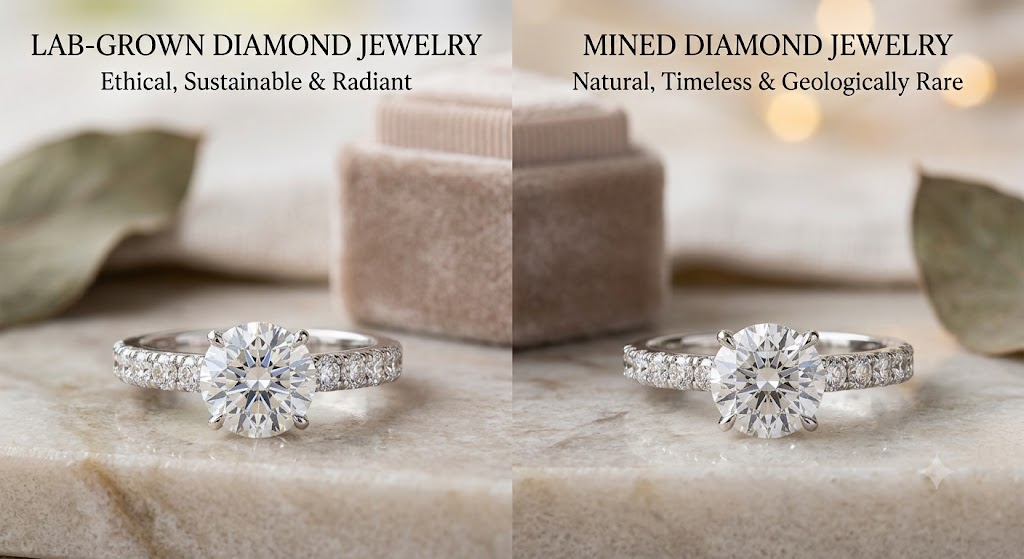
My aunt asked me last month if my cousin’s new engagement ring was “one of those fake diamonds.” She didn’t mean it unkindly; she genuinely wasn’t sure. Maybe someone said it to you the same way, with total confidence, or with a dismissive little wave of the hand. Either way, you’re here now wanting an actual answer before you make a decision that matters. Fair enough. Let’s settle it properly.
What Actually Makes a Diamond a Diamond
Before getting into whether lab-grown counts as “real,” it’s worth knowing what a diamond technically is. It’s carbon. Pure carbon atoms arranged into a specific crystal lattice structure called a diamond cubic. That arrangement is what gives a diamond its hardness, its brilliance, its ability to bend and scatter light the way nothing else quite does. The definition is entirely about atomic structure.
Nowhere in that definition does it say where the carbon came from, how long it took to arrange itself, or which continent it was dug out of. None of that is part of what makes a diamond a diamond.
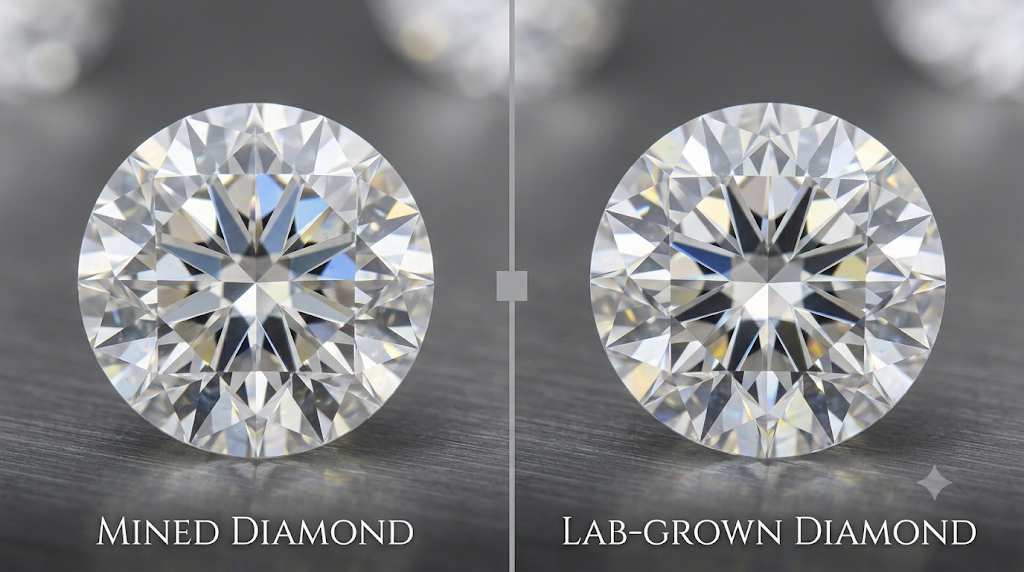
So by the only definition that actually holds up scientifically, a lab-grown diamond is unambiguously a real diamond. Same carbon composition. Same crystal structure. Same refractive index. Same hardness, a 10 on the Mohs scale. Hand a mined stone and a lab-grown one to a gemologist with a loupe and ask them to sort out which is which, and they can’t do it. Not because they’re bad at their job. There’s genuinely nothing visible to go on.
The “But It’s Not Natural” Argument, and Why It’s Weaker Than It Sounds
The most common pushback goes something like: “but a lab-grown diamond isn’t natural.”
Fair point, technically. It wasn’t formed in the earth. It was grown in a controlled environment by scientists who recreated the same extreme heat and pressure conditions found deep in the earth’s mantle.
But here’s a question worth actually sitting with: does origin decide authenticity?
Think about it for a second.
The water you drink from a purified bottle went through a treatment plant.
The honey you buy from a store came from bees kept in managed hives, not wild forests.
Pearls sold in the finest jewelry stores in the world are almost entirely cultured — meaning they were grown by placing an irritant inside a farmed oyster.
Nobody calls cultured pearls fake pearls. They are still pearls.
Nobody walks into a store and calls those fake pearls. They’re still pearls.
The “natural” argument is really a tradition argument wearing a lab coat. And that’s fine; tradition is allowed to matter, especially somewhere like India where jewelry carries genuine emotional weight. It just shouldn’t get mistaken for a factual claim about whether something is real.
What the Gemological Institutions Actually Say
This part isn’t really up for debate or opinion. The world’s leading gemological bodies have already weighed in, definitively.
The GIA, the Gemological Institute of America, about as authoritative as it gets in this industry, grades lab-grown diamonds and issues certificates for them exactly the way it does for mined ones. Same 4Cs grading system: cut, colour, clarity, carat. Same standards, same material, no asterisk.
The IGI, the International Gemological Institute, does the same thing.
When the organisations whose entire profession is understanding and classifying diamonds certify lab-grown stones using their standard system, that tells you something. They’re not making a charitable exception or inventing a separate, lesser category. They’re applying their existing rulebook because the material actually qualifies under it.
The Moissanite Confusion, Getting This Straight
A good chunk of the “lab-grown diamonds are fake” narrative comes down to a simple mix-up between lab-grown diamonds and diamond simulants.
Moissanite, cubic zirconia, and white sapphire all look like diamonds to an untrained eye, but they’re chemically and structurally nothing alike. Moissanite is silicon carbide. Cubic zirconia is zirconium dioxide. White sapphire is aluminium oxide. None of these is diamonds in any scientific sense; they’re a different material entirely that happens to sparkle similarly under the right light.
Lab-grown diamonds aren’t in that category at all. A lab-grown stone isn’t trying to imitate a diamond, and it doesn’t merely resemble one either. It is one, the same way identical twins share the same DNA even though they’ve got different stories about how they got here.
This distinction matters more than it sounds like it should. If someone tells you lab-grown diamonds are fake because they once saw a cubic zirconia up close and thought it looked “off,” they’re comparing two completely different things and drawing the wrong conclusion from it.
The Question That Actually Gets Asked at Home
Let’s not pretend this is only an academic debate. In Indian families, “is it real?” carries real social and emotional weight. Jewelry here isn’t just decorative; it’s a marker of occasion, of sentiment, of status, in ways that go deeper than most Western contexts really account for.
So when a mother-in-law or a relative asks whether your solitaire is “real,” what they’re usually actually asking is something closer to: will it hold up? Will it still sparkle twenty years from now? Is this something worth keeping and eventually passing down, or something you’ll quietly regret?
The answer to all of that is yes. A lab-grown diamond doesn’t degrade. It doesn’t cloud, and it doesn’t lose its sparkle or hardness over time. The stone you buy today will look identical in thirty years. Your daughter can wear it. Her daughter can wear it after that. There’s no expiry date built into the stone itself.
What might change, and it’s worth being upfront about this, is resale value. Lab-grown diamonds don’t hold resale value the way mined diamonds have traditionally been assumed to. But mined diamonds have also seen real price shifts in recent years, and honestly, resale value in diamonds generally, mined or lab-grown, was always more myth than reality for most everyday buyers.
If you’re buying a diamond as a financial investment, both categories deserve honest scrutiny, and neither is a sure thing. If you’re buying one to wear, to love, to mark an actual moment in your life, a lab-grown diamond delivers everything that matters, completely intact.
My brother-in-law wanted to surprise his wife with a solitaire for their 10th wedding anniversary. Like many buyers today, he found himself caught between emotion and practicality: should he choose a mined diamond or a lab-grown one?
One thing was certain-he wanted a diamond that would symbolise a love meant to last forever, with the same brilliance and beauty that he saw in his wife.
After carefully weighing the facts, he chose a lab-grown diamond. The decision not only gave him the same stunning beauty and durability he was looking for, but it also allowed him to make the most of his budget. Instead of buying just a solitaire ring, he was able to purchase both a beautiful solitaire ring and a matching pair of solitaire stud earrings.
When his wife opened the gift, her reaction was priceless. She was deeply touched, and seeing her joy made the decision even more meaningful for him. In the end, it wasn’t about where the diamond came from-it was about the love, thoughtfulness, and memories it represented.
One More Thing Worth Saying
There’s a version of this whole debate that has less to do with gemology and more to do with commerce. The mined diamond industry has a very real financial interest in keeping the perception alive that lab-grown diamonds are somehow inferior or inauthentic. Billions of dollars in revenue depend on that narrative sticking.
That doesn’t make everyone who prefers mined diamonds wrong, or naive. Personal preference is real, and it’s valid. But it does mean that the next time you hear someone state, with total confidence, that lab-grown diamonds are “fake,” it’s worth asking what they’re basing that on, and who actually benefits from you believing it.
Knowing what you’re buying, and why it costs what it costs, is just being a smart consumer.
So, Are Lab-Grown Diamonds Real?
Yes. Completely, scientifically, certifiably yes.
They’re real diamonds, grown through human ingenuity instead of geological accident. They sparkle the same, they last the same, they’re graded by the same institutions using the same standards. And more people, every year, are choosing them, wanting the beauty of a diamond without the baggage of an industry built on scarcity and secrecy.
Ready to find a diamond that matches your values and your vision?
Frequently Asked Questions
Can a jeweler tell if a diamond is lab-grown?
No, not with a loupe or a standard microscope. Telling the two apart takes specialised testing equipment that’s typically only found in gemological laboratories.
Do lab-grown diamonds get cloudy over time?
No. They share the exact same chemical structure as mined diamonds, so they’re just as durable and permanent, no clouding, no discolouration, no loss of sparkle.
Is a lab-grown diamond the same as cubic zirconia?
No. Cubic zirconia and moissanite are diamond simulants; they look somewhat similar but are made of completely different materials. A lab-grown diamond is pure carbon, identical in every physical and chemical way to a mined one.
Are lab-grown diamonds GIA or IGI certified?
Yes. Reputable lab-grown diamonds are graded by the same leading institutions, including GIA and IGI, using the identical 4Cs standard (cut, colour, clarity, carat) applied to mined diamonds.