
Put ten diamonds on a velvet tray. We’ve run this test with customers in the store. Five grown in a lab, five pulled from the ground. Now ask someone to sort them into two piles. They’ll fail. The salesperson behind the jewelry counter will fail. Your uncle who has been in the trade for thirty years will fail. A trained gemologist working with nothing but their eyes will fail too. The stones just sit there, identical in every way you can actually see, quietly making the whole argument look a little silly.
And yet the argument carries on. So let’s walk through it properly. No agenda, no sales pitch dressed up as advice.
What Is Genuinely, Completely the Same
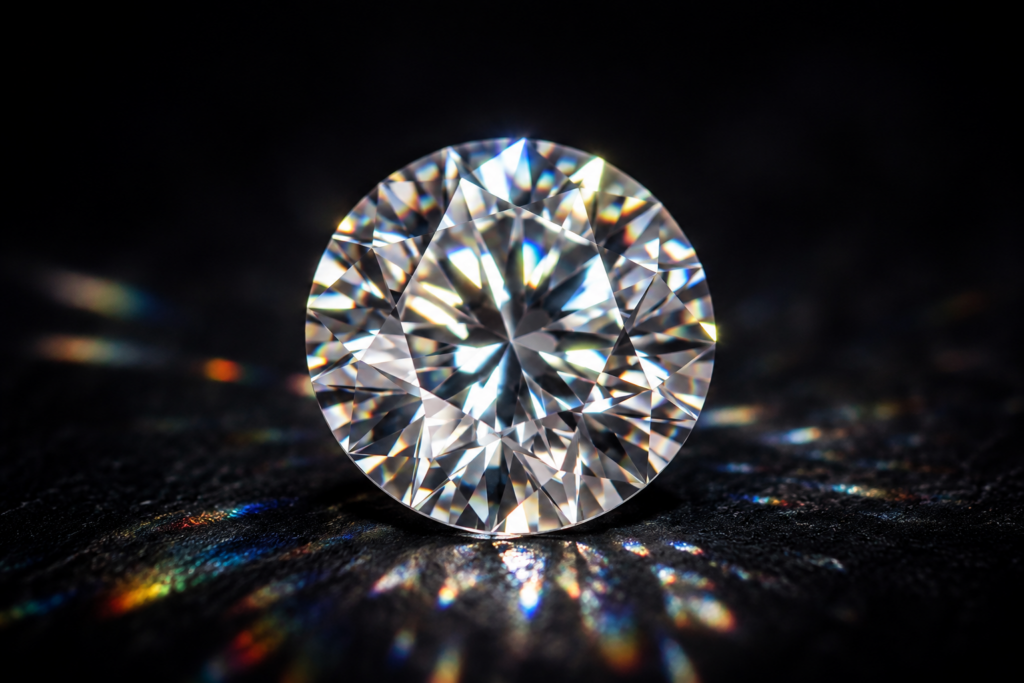
Start here, because this list runs longer than most people expect.
- Chemical composition: Identical. Both are pure crystallized carbon locked into the same diamond cubic lattice. Not similar, not close. The same material, atom for atom.
- Hardness: Both score a 10 on the Mohs scale, the hardest natural material we know of. A lab-grown stone will scratch glass, cut steel, and shrug off decades of daily wear exactly the way a mined one does.
- Brilliance and fire: That signature sparkle, the rainbow flashes, the depth of shine- all of it comes from the crystal structure and the way the stone is cut. Same material, same cutters, same technique, same result.
- Grading standards: Both go through the 4Cs- cut, color, clarity and carat- at the same labs. IGI and GIA do not use a gentler scale for lab-grown stones. Same rigour, same scrutiny.
- Durability over time: Neither clouds, dulls, nor quietly loses its properties over the years. A lab-grown diamond ages the way a mined one does, which is to say it barely ages at all.
That is a long list of sameness. Keep it in mind as we go.
The Real Differences Between Lab-Grown and Mined Diamonds
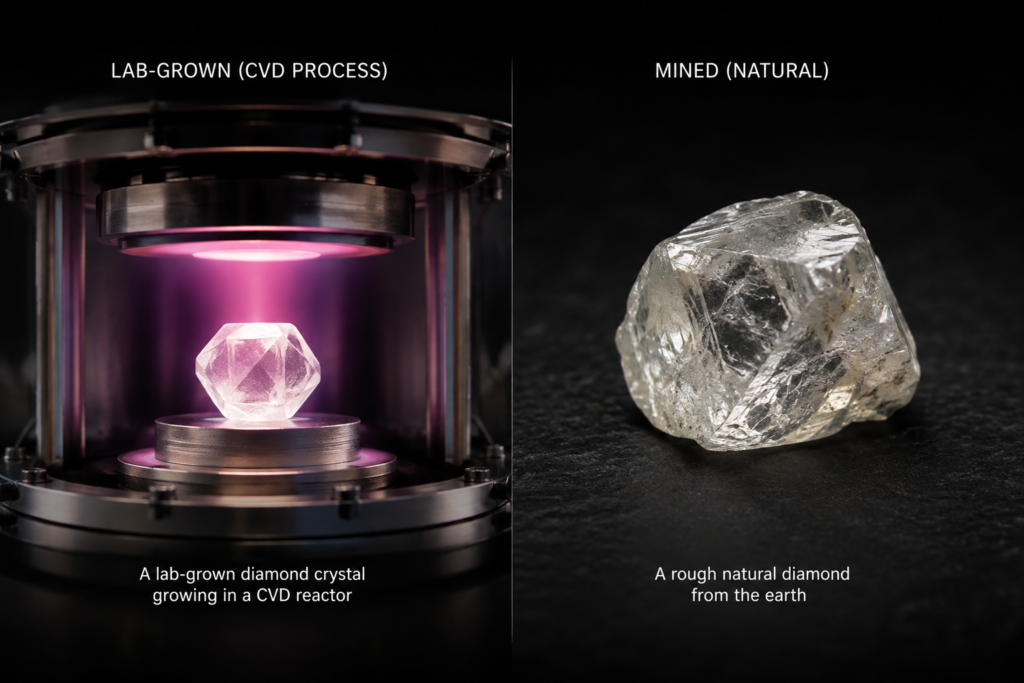
- Origin and formation time: The obvious one. A mined diamond formed somewhere between one and three billion years ago, roughly 150 to 200 kilometres below the surface, under punishing heat and pressure, before hitching a ride up on ancient volcanic activity. A lab-grown diamond forms in a controlled chamber over a matter of weeks, using HPHT or CVD to recreate those same conditions on a compressed clock. Does the origin change the stone itself? Scientifically, no. Does it matter to you? That is a genuinely personal question, and either answer is a fair one.
- Price: A lab-grown diamond typically costs 50 to 70 per cent less than a mined stone of comparable grade.In our own collection, thats often the gap between half carat an full carat for full spend. Not because the quality is lower, but because the supply chain is shorter and nobody is manufacturing scarcity along the way. Think of two bottles of water, one filtered through mountain rock over centuries, one purified this morning by modern technology. Both are clean. Both hydrate you the same. One has the more poetic backstory, and that story is what you’re being asked to pay extra for.
- Resale value: Here, honesty needs a little room. Mined diamonds have historically held their resale value better than lab-grown. As lab-grown production scaled over the last five years, lab-grown prices came down considerably. But mined resale has slipped too, and it’s worth saying why: the entire secondary market is softening as buyer demand shifts toward lab-grown, so appetite for second-hand mined stones is thinning right alongside it. The old idea that a mined diamond is a dependable financial investment was always a bit oversold. Most people never sell the ring anyway. It stays in the family and gets handed down. Seen that way, the resale conversation barely registers for the average buyer. Honestly, in 20 years I’ve had maybe a handful of customers ever ask about reselling and actually comes for the same.
- Tiny inclusions under magnification: A genuinely interesting one. Turn the magnification right up, and the inclusion patterns can differ, because the two growth processes leave slightly different fingerprints. With the right equipment and enough training, a gemologist can sometimes identify a stone as lab-grown from these microscopic clues. Step back to any normal viewing distance, though, and there is simply nothing to see.
- Environmental and ethical footprint: Mining carries a heavy load: disturbed land, serious water use, carbon from the heavy machinery. Lab-grown isn’t spotless either, since growing a diamond takes real energy, but the overall impact lands lower, especially when that energy comes from renewable sources. The conflict-free question is cleaner too. A shorter supply chain is a far easier one to trace.
The Comparison That Actually Helps
Picture two identical silk sarees. One was woven by hand in Varanasi, the craft passed down through a family for generations. The other came off a modern loom that reproduces the same weave, the same thread count, the same pattern with extraordinary precision.
Both are silk. Both are beautiful. Both will drape the same, last the same, feel the same against your skin. The handwoven one carries a story of human hands and time, and some people will gladly pay a good deal more for that story. The other offers the same quality with a different origin at a different price.
Neither is fake. Neither is lesser. The only real question is which one matters to you.If you’re still on the fence, come look. That’s genuinely the fastest way to decide.
So When Does the Choice Actually Matter?
If you are buying a diamond as a financial asset, watching resale trends and thinking about what you could get back for it, then a mined stone still holds a slim edge for now, though that edge is narrowing. If that’s you, be honest with yourself about it.
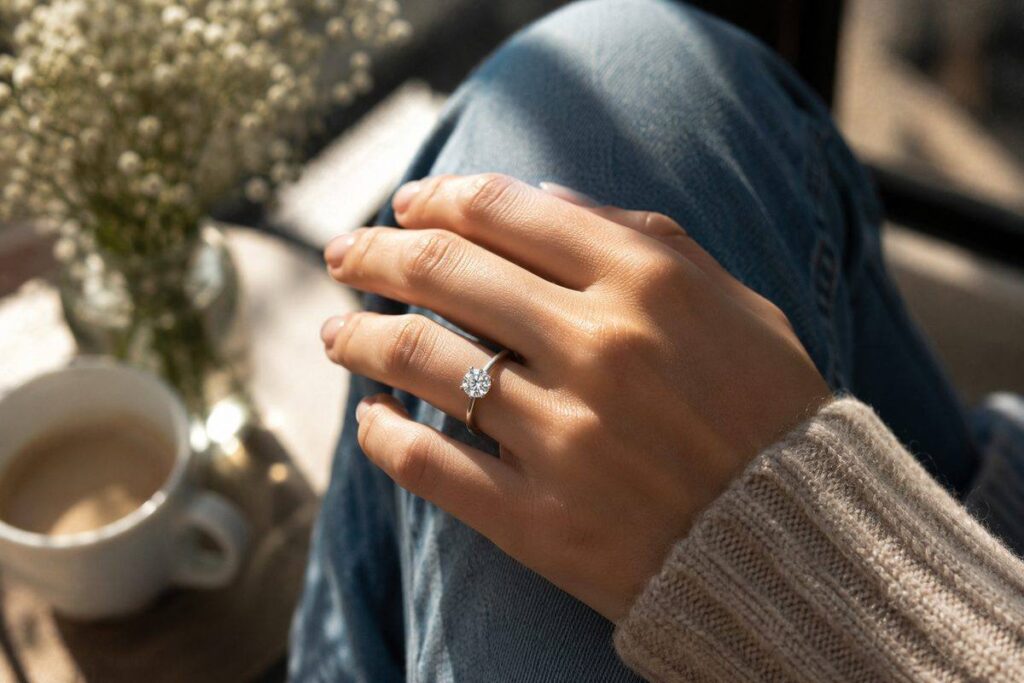
If you are buying a diamond to wear, to mark a moment, to hand down to someone you love, to catch your eye every morning as a reminder of something that matters, then the lab-grown versus mined distinction becomes almost entirely philosophical. Same sparkle. Same toughness. Same grade on paper. And considerably less money, which leaves room to go up a size, choose a finer cut, or simply keep the difference.
The Bottom Line on Lab-Grown vs Mined Diamonds
The sameness list is long. The difference list is short. And most of what sits on that difference list comes down to two things: where the stone came from and what it costs. Not quality. Not beauty. Not how long it will last.
Get that clear in your head, and you are in a far stronger position to choose a diamond that actually fits your life, your values and your budget as an modern consumer.